




Blog
Interview: Unlocking the Future of Brand Protection with Corsearch LABS
- Brand Protection

Corsearch is excited to introduce ‘Corsearch LABS’, a dedicated product venture builder established within the company to drive aggressive experimentation and innovation.
We sat down with Pietro Gagliano, Head of Corsearch LABS, in Paris to discuss this new initiative, its mission, and what it means for the future of Brand Protection and our clients.
About Pietro
Pietro Gagliano is a leading voice in the world of Brand Protection and serves on the INTA Anti-Counterfeiting Committee Leadership Team and is an active member of the sustainability and enforcement committees for Indicam, ACG, and Andema.
What is Corsearch LABS?
Corsearch: Pietro, thank you for joining us. To kick things off, can you explain what Corsearch LABS is, especially in relation to the wider Corsearch ecosystem?
Pietro: Absolutely. The Corsearch LABS is essentially a product venture builder within Corsearch. You can imagine it as an island within the company. It’s built like a small startup within the larger Corsearch ecosystem, complete with its own dedicated product team, engineering team, and commercial team.
Corsearch: That almost sounds like an internal startup?
Pietro: That’s exactly the operational model. Crucially, everything we do in the LABS works in parallel with the core activities driven by the main Corsearch tech and product team. We’re working on new projects and initiatives that we believe could become the next big thing in brand protection.
Corsearch: Do you see any comparable models in the market today?
Pietro: While there is nothing directly comparable within Brand Protection itself, because historically, Brand Protection was not an industry focused on technological innovation. We could make a very loose comparison to how Google set up Google X for their innovation lab.
They have their core business, but they dedicate resources to a group of people tasked with building something entirely new, like Gmail or Google Calendar, which didn’t exist when the company launched.
It reminds me a little of how Paris was built. Everything started with the Notre Dame, and then the city spiralled outwards like a snail, with each new area revolving around the centre. So you simply expand the value proposition and scope of what you’re doing. This is what we’re doing with LABS, building an area adjacent to the core product vision and mission.
The Strategic Imperative: Why a Separate Entity?
Corsearch: Why was it so important to establish LABS as a separate entity rather than just integrating it as another division or team within the main structure?
Pietro: The primary reason is to avoid distraction. The core tech and product teams have a clear roadmap – they know where the company is today (position A) and where it needs to be in three to five years (position B). Nothing should slow them down from reaching those core goals. The projects in LABS are new, complex, driven by innovation and require deep experimentation with our trusted partner. If the core team were constantly distracted by this, we may lose track of our most important objectives.
Corsearch: So, it’s about giving innovation its own dedicated highway without interfering with the main traffic flow.
Pietro: That’s a great analogy. It’s the same car, but on its own dedicated highway. Everything we build is always connected to the core center, but we are expanding the value proposition and the scope of what we’re doing.
The Driving Force and Core Mission
Corsearch: What is the Lab’s core mission and how do you decide what projects to pursue?
Pietro: The soul of LABS is driven by people who are committed to making a real impact. Our projects often come about because clients who trust Corsearch’s technology and engineering team approach us with a problem. They’ll ask, “Can you help us solve this other problem?“, we’ll look at a shortlist of potential issues (we have about 20 on our list today) and work to build a solution that is both relevant and potentially can be used by a broader audience.
Corsearch: What is the ultimate goal for a successful project coming out of LABS?
Pietro: Our goal is to build solutions that solve major industry challenges and that can be scaled to a broader Corsearch customer base and beyond. At this point, the solution will move from the LABS to the core tech and product Corsearch team. They then finish the product and integrate it, ensuring the product is ready to be scaled.
Flagship Success and Product Impact
Corsearch: Can you share some of the flagship projects that have emerged from Corsearch LABS, and the foundation they were built on?
Pietro: The foundation of all our products is Zeal, and our main product that has come out of LABS and is still under expansion is CVAN. It is finished on the IP violation side, but we are also expanding its capabilities to support marketplaces, and social media on multiple levels. We also have a second project focusing on image right compliance.
Corsearch: How significant is the impact of a solution like the image right compliance tool?
Pietro: The impact is massive, for example a client asked us to build the image right compliance solution and they had 181 people hired to manually go on the web and check for images. By using CVAN, they’ve been able to potentially reduce that manual effort by over 90%. This is a prime example of how we substitute error-prone, manually intensive processes with scalable technology.
Corsearch: That’s an incredible leap in efficiency and value.
Expanding the Customer Base and Future Markets
Corsearch: Corsearch has historically focused on serving brand clients. Is LABS helping to diversify your customer base?
Pietro: Yes. Historically, Corsearch had only one client type: brands. Now, with CVAN, we are entering the platform market, serving social media and marketplace clients. This collaboration with multiple stakeholders in the industry is key to succeed in such a complex and constantly evolving industry.
The Brand Protection Landscape and 2026 Predictions
Corsearch: The volume of threats must be one of the biggest challenges right now.
Pietro: It is. The scale of the counterfeit market has grown five to six times larger than it was 10 years ago. The nature of counterfeiting is shifting from large, B2B shipments to small, direct-to-consumer (D2C) parcels – especially through marketplaces and platforms – making it much harder for brands and authorities to control. The D2C growth is a huge issue because it removes the middlemen who historically provided screening or protection, increasing product safety risks.
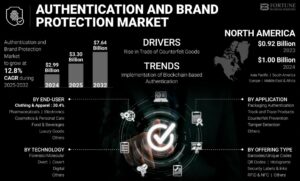
Source: Fortune Business Insights
Corsearch: I understand a key law change is coming into effect regarding small parcels.
Pietro: Yes. Historically, any parcel below €800 was essentially an “open road” for counterfeits, as authorities couldn’t physically check the immense volume. Bad actors exploited this by switching their distribution from large containers to millions of small, individual parcels. Now, in Europe, from January 1st next year, the law changes so that every parcel must be checked. These ‘offline’ changes in seller behaviour are directly impacting the scale of ‘online’ enforcements that we are seeing.
Corsearch: That’s a huge operational hurdle.
Pietro: The authorities and businesses simply cannot keep up with the volume. This has led to bad actors using clever workarounds, such as moving goods via the Silk Belt Road or through countries like Cambodia and Paraguay, which have favorable economic or debt-related ties to China, creating routes where packages are not checked. This constant need to find a workaround is why the market is evolving so rapidly, as the ‘offline’ problem has become so big that we’re seeing ‘online’ start to follow the same trend of being too big to tackle.
Corsearch: What value will LABS bring to the market? If you could put that in a sentence.
Pietro: We are bringing innovation to spaces where there is much need. Online Brand Protection is a space that needs innovation. This core innovation is coming from Corsearch.
There wasn’t an existing solution that lets brands and platforms jointly solve this problem at scale – LABS has created that solution.
Corsearch: Given this intense environment, what are your three biggest predictions for the market looking ahead to 2026?
The Counterfeit Market Will Keep Growing
Pietro: The market will continue its rapid growth, driven by bad actors exploiting new technologies like AI and geopolitical loopholes to change distribution routes and avoid sanctions. However, the innovation coming from Corsearch means we are putting ourselves in a position to invert the trend.
Increased Diversification of Threats
Pietro: The threats we face are becoming incredibly diverse and rapidly evolving. It’s not just about simple counterfeits; we are seeing new phenomena like “dupes,” massive ad-based scams on platforms, deepfakes for crypto or for personal exploitation, and even sophisticated ads scams to drive people on fake/phishing websites. Bad actors move quickly to exploit areas where there is no current defense.
2026 Is A Year of Hope
Pietro: By 2026, we hope to be in a strong position to win this battle against the growing market. Our goal is to go as close to the source as possible with CVAN – stopping a transaction even before a listing is created – and using technology to reduce the pressure on manual teams, pushing the entire industry forward.
Corsearch: A year of hope – a great place to end. Pietro, thank you for sharing these insights into Corsearch LABS and the future of Brand Protection.