







.svg)
.avif)






.svg)



Corsearch research reveals that 1 in 5 fake listings come from only 3% of illicit sellers. Up to $78bn in annual losses could be prevented if platforms proactively removed these repeat infringers.
Corsearch’s recent white paper provides brands, e-commerce platforms and legislators with data on the proportion of repeat infringements undertaken by the same sellers, who use key global online marketplaces and social media platforms to infringe intellectual property.
The white paper also reports on the policies and procedures for repeat infringements currently employed by major online e-commerce platforms.
Finally, it presents detailed findings on the reduction in online counterfeiting and the commercial savings that could be secured if key e-commerce platforms combined:
- 1. robust seller verification; and
- 2. a “three strikes and out” rule.
What is a repeat breacher?
For the purpose of our study, we define repeat breachers as sellers that host multiple listings which infringe brand owners’ intellectual property (and/or repeatedly infringe platform policies).
E-commerce platforms and repeat breachers
Forrester estimates that 82% of global B2C e-commerce growth over the past few years came from marketplaces [1]. Bad actors have been swift to exploit this growth, with the global economic value of counterfeiting and piracy potentially reaching $4.2 trillion USD by 2022 placing 5.4 million legitimate jobs at risk [2].
Corsearch’s data shows that the proportion of sellers who repeatedly infringe rights and harm consumers typically comprises under 3% of the total sellers enforced, but these sellers are responsible, on average, for over 20% of the illicit issues detected and notified on the e-commerce operations considered in the study.
Draft legislation in both the US (such as the SHOP SAFE and SANTA Acts) and Europe (such as the Digital Services Act) contemplates requiring online e-commerce platforms to take steps to verify and authenticate sellers and promoters before they can use the platform. The legislation also considers requiring these platforms to implement policies to stop sellers who repeatedly infringe intellectual property. You can read a summary of the draft legislation here.
Our white paper focuses on providing evidence to inform the discussion on proposed legislative changes. The following is an example of what can occur in the absence of a seller verification and a three-strikes rule:
In the course of 2020, a seller used the same e-commerce operation in Latin America to offer consumer goods for sale. In total, Breaches in respect of 9 different consumer brands were found by Corsearch’s technology. On each occasion, Corsearch’s technology notified the e-commerce operation of the Breach and the seller’s online identification. The e-commerce operation was asked to remove the offer for sale. Over the course of a year, 107 different Breaches were identified. On one day, 27 separate Breaches that each offered a fake or inferior product for sale were reported to the e-commerce operation.
This bar chart below identifies the time period for the Breaches and notifications to the e-commerce operation.
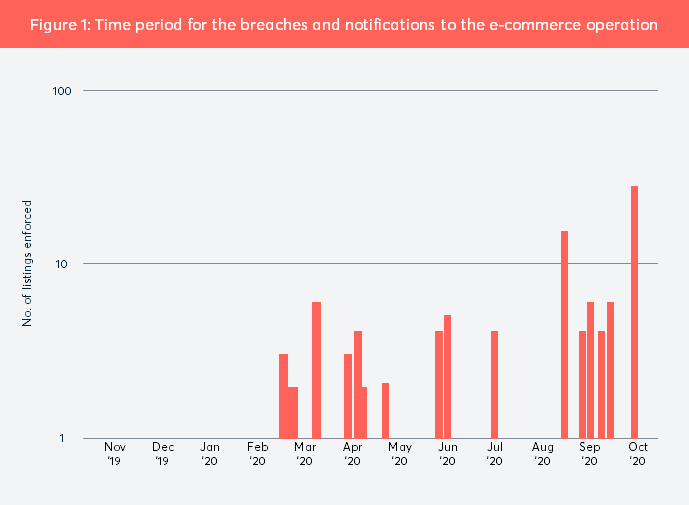
Although this e-commerce operation was notified about the same seller on 27 separate days - and with increasing frequency, this seller was not suspended. The seller was free to continue to use the platform to offer goods that might place consumers at risk.
Current Platform Policies
Platforms can protect both brands and consumers by effectively tackling repeat breachers. However, policies currently adopted by many platforms do not do enough to prevent repeat infringement.
Our findings indicate:
- 23 out of the 34 platforms investigated have a policy against repeat breachers that is readily available to users - the remaining 11 have no relevant policy evident.
- Out of the 23 platforms that have a policy directed at repeat breachers, only 3 have a policy which includes the 3-strike rule. These 3 platforms are based in the APAC region, and three serious offences on separate occasions result in account termination.
10 out of 23 platforms with a relevant policy have published definitions of the duration of account suspension. Again, amongst these 10 platforms only 2 have a policy that considers repeat offences sufficient ground for immediate termination.
It is noticeable that platforms like Aliexpress, which has a clear ‘three strikes’ rule and robust seller verification process, sees fewer repeat breaches than other platforms. Similarly, while Facebook and Instagram prefer not to disclose their policies publicly (to avoid gaming by bad actors), we are aware that they pay close attention to the issue of repeat breaches.
New methods for tackling repeat breachers
Robust seller verification
Platforms could require sellers to verify their identity before allowing them to advertise products for sale. This would serve to dissuade some bad actors from using these platforms, while also making enforcement and further action easier if they do go through the verification process. Seller verification is commonly achieved through credit card, bank statements or utility bills, or through government-issued identification cards.
Some platforms, such as Amazon and Alibaba, have already brought in forms of seller verification – although these policies could be strengthened. Others have yet to commit to seller verification, and consumers continue to be put at risk by anonymous seller accounts.
Additional to robust seller verification, platforms should bring in a simple ‘three-strikes-and-out’ policy to tackle repeat infringement. Below, we have outlined two different thresholds that could be adopted.
Three Strikes and Out Model 1: Threshold = 3 separate days of enforcement
Platforms could adopt a policy where a seller is blocked from advertising further products for sale when a limit of 3 separate days of enforcement is reached.
Three Strikes and Out Model 2: Threshold = 3 enforced listings
Alternatively, platforms could adopt a policy where a seller is blocked from advertising further listings when a limit of 3 enforced listings is reached. In the White Paper, this is modelled by grouping data based on the number of separate listings that have been enforced.
Three Strikes in action - Japanese marketplace
A seller used an e-commerce platform in Japan and created 2,063 separate listings under the same name for products copying the intellectual property of a fashion brand protected by Corsearch. Corsearch’s technology discovered these listings as they appeared over the course of the year. Each time listings were discovered, notices were sent to the e-commerce operation to remove the products. Notices were sent on 42 separate days over the course of the year. Each time, the notified listings were removed by the platform, but the seller was able to continue listing offers on that platform.
If the seller had been stopped from using the marketplace after 3 listings were reported and removed, at least 2,060 of the seller’s infringing listings would not have required enforcement (see figure 2 below).
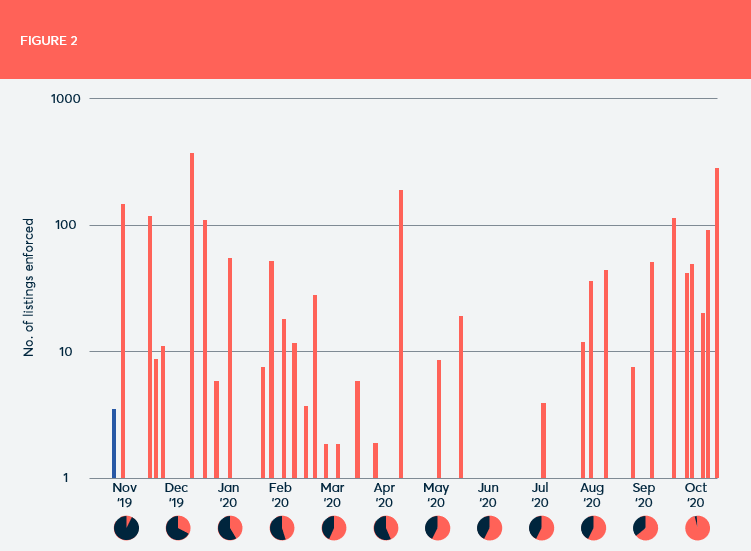
Key:
BLUE = listings enforced before the cut-off point had been reached.
RED = listings enforced after the cut-off point had been reached.
The impact of tackling repeat breachers
Corsearch’s analysis shows that:
- Only 6% of sellers are repeatedly enforced on 3 days or more
- However, these sellers are responsible for over 24% of the listings Corsearch has enforced against
- The models show that a seller verification and repeat breacher policy would benefit consumers, brands, legislators, and the platforms themselves
1. Commercial savings
Implementing either of these models could deliver reduce the availability of potentially harmful or low quality, non-genuine products to consumers by a minimum of 11% (Model 1) or up to 24% (Model 2). Given the losses suffered to online counterfeiting are estimated at over $320bn annually, this could equate to consumer savings of $35bn under Model 1 and up to $78bn under Model 2.
2. Protecting consumers
However, the benefit is not just financial. Non-genuine listings and counterfeits are often low-quality products, or those that may not meet regulatory standards, and are therefore highly likely to pose risks to consumer health and safety.
3. Platforms benefit
Additionally, given research suggests 33% of consumers hold e-commerce operation responsible for addressing these issues, and 64% of consumers have lost trust in a platform after unintentionally buying counterfeit products on that platform, addressing this issue effectively is also likely to drive the commercial success of e-commerce marketplaces [3].
Download the white paper
Corsearch has analyzed over 1.5m enforcements to help understand the scale of the issue and how brands, platforms and legislators can address the challenge of repeat offenders to protect consumers, reduce losses suffered to counterfeiting and support rights holders.
Corsearch's analysis shows that a significant volume of counterfeiting and other brand misuse online could be stamped out if platforms implemented a strong verification process and one of the “three-strikes-and-out” policies put forward by Corsearch.
Access the white paper to learn:
- The key dynamics in the e-commerce market and the shifting regulatory landscape
- The true scale of repeat infringement on ecommerce platforms
- How simple platform policy changes could drive significant impact
References
[1] Marketplaces Make Their Mark In The Channel (Forrester): https://go.forrester.com/blogs/marketplaces-make-their-mark-in-the-channel/
[2] Global impacts of counterfeiting and piracy to reach US$4.2 trillion by 2022 (ICC): https://iccwbo.org/media-wall/news-speeches/global-impacts-counterfeiting-piracy-reach-us4-2-trillion-2022/
[3] 10 Independent research by Sapio Research (Incopro): https://corsearch.com/content-library/ebooks/living-in-a-fake-society-us/
See how PharmaCheck™ accelerates name qualification
From early-stage screening to post-clearance checks, we help you move faster with confidence — while avoiding missteps new, and help you move forward — faster.
Similar resources



Research Indicates That 40% of Football Jersey Mystery Boxes Are Counterfeit



Moving from Defense to Offense: A Strategic Framework for Brand Protection

The Intersection of AI and Brand Protection in 2026

.avif)
.avif)
