






.svg)
.avif)





.avif)



What is Intellectual Property (IP)?
Intellectual property (IP) generally refers to something you have created that is unique.
This can include:
- Business names
- Slogans
- Logos
- Designs
- Colors
- Software
- Domain names (website addresses)
- Documentation
- Music
- Symbols
These inventions, creative works, and ideas are some of the most important aspects of a business - that’s why it is crucial to ensure you have the tools in place to prevent the unauthorized use or reproduction of your IP assets and have a firm understanding of intellectual property law.
A new intellectual property asset is not normally given a ‘copyright’ automatically - to secure your IP you need to submit a request for a ‘registered copyright’ which acts as formal recognition of your created work and provides more legal security if a dispute were to arise.
Copyrights protect creators against the ability for others to reproduce, distribute, display, perform and create derivative works based on the original creation.
The Importance of Intellectual Property Protection
Having a strategic and carefully planned IP strategy is vital to protecting the legal assets of a business - IP can also be leveraged to inform business decisions and provide business intelligence between departments.
By having a robust IP strategy in place you can:
- Enhance market value
- Attract investors and partners
- Turn ideas into profit-making assets
- Market your products and services
- Gain a competitive edge
- Enhance export opportunities
- Avoid and mitigate risks
Who is responsible for Intellectual Property protection?
Intellectual Property protection is primarily the responsibility of the creators, inventors, or owners of the IP.
However, the enforcement and legal aspects of IP protection may require a collaborative effort from individuals, organizations, and government bodies.
As well as understanding the business benefits, you also need to be aware of what happens when you don't protect your IP.
What happens when Intellectual Property isn’t protected?
Not having the right Intellectual Property protection in place or a comprehensive understanding of what qualifies as intellectual property infringement can have a significant impact on your company’s ability to grow and become profitable.
There are thousands of examples online, showcasing the detrimental impact on businesses when they lose control of their brand identity. Poor-quality counterfeits, social media scams and inappropriate brand associations all contribute to an erosion of trust, which can lead to a significant dent in your reputation and financial loss.
Bad actors and criminals move fast and any sign of weakness can be exploited to secure their own financial success. Unfortunately, they can also be very good at what they do, meaning consumers can be none the wiser when it comes to telling apart the real from the fake.
If your IP isn’t secured, consumers can lose trust in a brand after unintentionally purchasing counterfeit goods online - it is down to businesses to ensure they are taking the right precautions to stop bad actors and criminals in their tracks to prevent this breach of trust.
As well as intentional infringement, sometimes a company can infringe another company's intellectual property rights without realizing it. Businesses have a responsibility to ensure that they are aware of not only the IP threats, but also the rules and IP laws in place to avoid unintentional infringement.
A landmark IP Commission Report estimated that intellectual property theft has cost the US up to $600 billion annually, highlighting a massive and ongoing financial threat to modern enterprises.
Who are the bad actors?
Bad actors vary in their sophistication and the complexity of their illegal operations,
While some are simply trying to make quick cash by creating fakes or cheap knockoffs, others have far more sophisticated scams in place that target companies persistently.
These include repeat infringers, who consistently adapt their tactics to make them harder to detect and penalize - through to criminal networks, which could be made up of hundreds of employees operating as its own business, creating multiple pages, listings and profiles across different platforms.
All of these factors create real challenges when trying to protect your intellectual property.
Who and what do they target?
The most common brands, types of products, and trademarks targeted include:
- Products that are finite or limited run
- Products that aren’t finite, but demand exceeds their supply
- Products that aren’t available in certain regions
- Products that have a high markup
- Products that are simple to copy
- Brands known for great customer service
- Brands and trademarks with global appeal
- Trademarks that are easily misspelled
The Intellectual Property Protection Tools at Your Disposal
There are many intellectual property examples as this is a broad term that encompasses several categories. Each of these categories comes with their own sets of rules and protections, so it is important to be aware of the different types of Intellectual Property Rights (IPR) and what they protect against.
Copyrights
A Copyright protects your creative works and grants exclusive protection to creators of original works and stops people using your work without permission or claiming it as their own.
Copyright law relates to expressions of ideas in material form. This includes things such as writing and literary works, art, photography, cinematography, audio, web content and software.
It is important to note that copyright only relates to the tangible expression of ideas, not the ideas themselves. Things such as titles, names, slogans, or concepts aren't included.
Copyright protects creators against the ability to reproduce, distribute, display, perform and create derivative works based on the original creation. While copyrights are normally granted automatically upon creation of the work, obtaining a registered copyright provides you with much more protection.
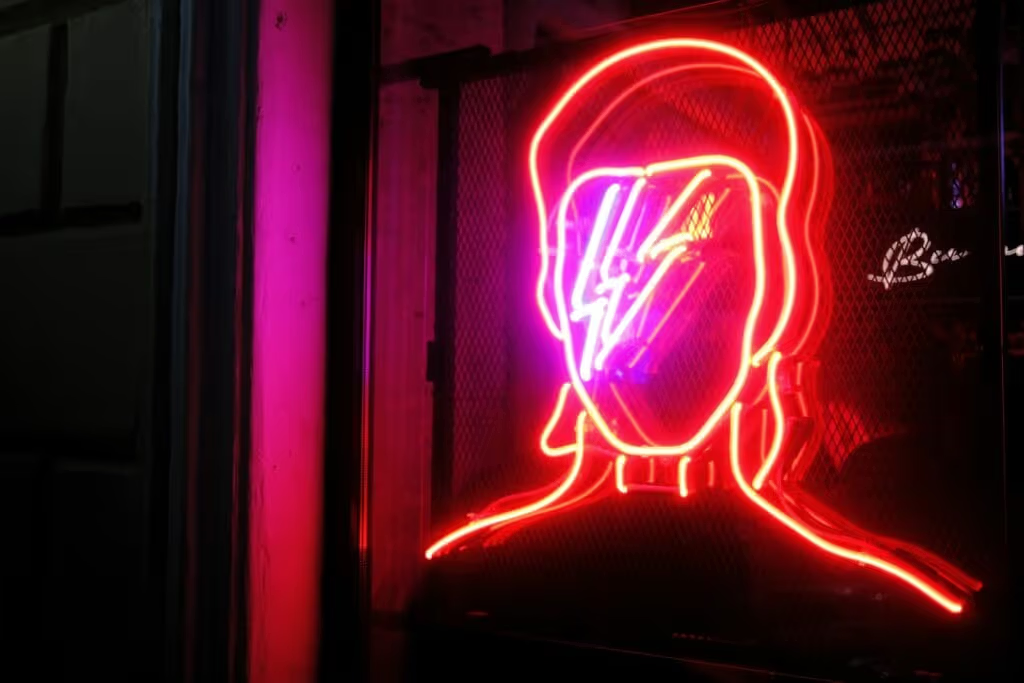
Case spotlight: Vanilla Ice vs David Bowie & Queen
If you want to use or sample a piece of music that you didn't create, you must ask for permission. This was something Texan-born rapper and actor Vanilla Ice forgot to do when he produced his 1990 hit track 'Ice, Ice, Baby'. The riff on the track was alleged to be sampled from David Bowie and Queen's 1981 hit 'Under Pressure’, however neither of the artists were credited or offered royalties by Vanilla Ice, leading to a legal dispute.
The case was settled privately out of court, with Vanilla Ice believing to have paid $4 million to purchase publishing rights to the track and crediting David Bowie and Queen as songwriters.
Trademarks
Trademarks protect your brand identity and are used to protect brand names, words and logos associated with products or services. They play a crucial role when it comes to protecting your brand from others and have a significant impact on marketplace recognition.
You can register a trademark as a multitude of things, such as logos, slogans, designs, colors, sounds, and even scents. As long as they are distinctive and recognizable, they can be registered and associated with your brand.
There are also many things you cannot trademark. Names and logos that are similar to existing trademarks and generic terms and phrases that aren't recognizable on a brand level do not meet the criteria and cannot be protected.
It is also worth noting there are different levels of protection available, depending on whether you have a registered or unregistered trademark. Many countries give you the option to use words, phrases or logos as a trademark to identify you or your company as the source of certain products or services without having to apply to register a trademark. This is known as 'common law’ and the rights granted differ depending on regional requirements.
By registering your trademark, you get nationwide protection across the country where it is registered, legal presumption of ownership and validity, use of the ® symbol next to your brand or business name and exclusive rights to use, license, franchise or sell your mark.
“85% of brands say they have experienced trademark infringement.”
Source: MarketingWeek
Case spotlight: Louis Vuitton vs Louis Vuiton Dak
Louis Vuitton is a globally recognized brand that operates in 50 countries with more than 460 stores worldwide. As well as trademarking 'Louis Vuitton', its initials 'LV’ have also been trademarked since 1890.
Trouble occurred a few years ago, when a Korean fried chicken restaurant, 'Louis Vuiton Dak', was sent a cease-and-desist letter from Louis Vuitton, who believed the restaurant's name was too similar to theirs. In addition, Louis Vuitton claimed the restaurant's logo and packaging was also remarkably like their imagery, citing it would cause customer confusion.
The court ruled the case in the designer’s favor and ordered the restaurant to change their name. Trouble did not end there however, as the restaurant was then hit with a $12,500 fine.
Patents
Patents are designed to protect the workings of an invention, such as a tool, a machine or a process. Patents can only be obtained if your invention is something that can be made or used, has a technical effect, and is new rather than a moderation of something that already exists.
Examples of patents include industrial processes, medicines, computer hardware, games and business methods.
Obtaining a patent prevents others from replicating, using or selling the invention and gives the patent holder sole rights to an invention, product or process.
Case spotlight: Polaroid vs Kodak
There have been a number of famous patent infringement cases to date, and one of the most famous cases took place in the 1970s between photography giants Kodak and Polaroid.
Edwin Land, the founder of Polaroid, had developed and patented the instant photography process that Polaroid is famous for. In 1976, Kodak launched its own line of instant cameras, prompting Polaroid to file a lawsuit against them, citing that no less than twelve of their patents regarding instant photography and the technology associated with it had been infringed.
This legal battle lasted for years, and eventually it was ruled that Kodak had infringed on Polaroid's patents. Kodak was ordered to cease production of its instant photography products and pay an eye-watering settlement of $925 million.

Designs
Design rights, otherwise known as industrial design rights, protect the appearance and look of a product you have designed, providing it is new and has individuality.
Design rights can be obtained for different visual forms, such as lines, shapes, textures and materials, and, like trademarks, designs can be registered or unregistered, depending on your location.
Under UK law, the shape and configuration of unregistered designs have protection against copying for 10 years after the design was first sold, or for 15 years after it was first created, whichever expires first. This is known as ‘design right’. You must also allow other people to use your industrial design if they ask during the final 5 years of protection. This is known as a ‘licence of right’.
The appearance of a product is protected in the UK and EU for only 3 years from the date you make your design public if it is not registered. It is also worth noting that the United States currently offers no legal protection for unregistered designs.
Registering designs provide much better protection for a longer period of time and provide the owner with exclusive rights to prevent unauthorized copying or imitation. They are also relatively low-cost and easy to obtain, offering a simple solution to increase the commercial value of your business or products.
Case spotlight: Adidas vs Payless
When you think of Adidas, its iconic three stripes are often the first thing that comes to mind.
These stripes were the cause of a famous lawsuit in 1994, where Adidas filed against value-priced retailer Payless, who were selling athletic shoes with two and four parallel stripes. The two companies managed to reach a settlement, however in 2001, Payless were found to be selling the lookalikes again. Adidas claimed the low-cost shoes on offer from Payless could tarnish its brand by association with a lower-quality product and demanded a jury trial.
Spanning seven years, the initial jury verdict was in favor of Adidas who were awarded a staggering $305 million, though a judge later reduced the damages to approximately $65 million.

Case Study: Goodai Global
Moving Beyond “Whack-a-Mole” to Intelligence-Led Brand Protection
Gyucheol, IP Manager at Goodai Global shares how Brand Protection is vital to protecting its intellectual property by having the ability to identify, enforce and remove counterfeit products to protect their brand identity and keep consumers safe.
Here’s what he had to say:
"Intelligence-led enforcement allows us to see the forest, not just the trees. We’ve moved beyond simple ‘whack-a-mole’ takedowns to identify and take action against the real targets."
Read the full case study on Goodai Global.
Once you have secured your IP portfolio including copyrights, trademarks and patents the next step is to monitor and enforce on infringement with a Brand Protection and Content Protection program.
Brand Protection
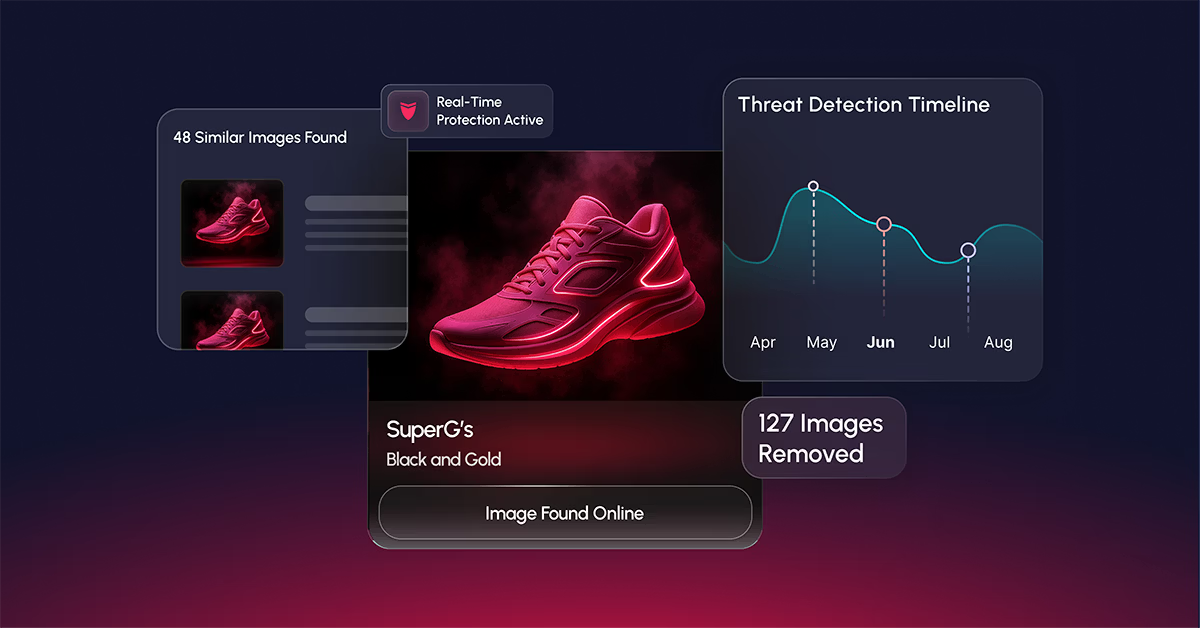
Brand Protection is a proactive, intelligence-driven strategy designed to safeguard a company's IP across the digital and physical landscape.
This includes hunting down counterfeits, gray market sales, domain impersonation, and direct trademark infringements across global marketplaces, websites, and social media platforms.
By rapidly identifying these hidden threats and tracing them back to their source, businesses are able to enforce their IP rights through swift content takedowns, domain recoveries, and deeper investigations that disrupt illicit supply chains.
Offline Investigations
High-volume online threats almost always originate in physical supply chains. When digital takedowns reach their limits, brands must bridge the gap between virtual marketplaces and real-world operations to stop counterfeiters at the source.
Transforming digital data into real-world disruption requires targeted, borderless investigations.
By executing covert test purchases, organizations secure physical evidence that directly feeds back into their online monitoring efforts.
This actionable intelligence allows organizations to trace anonymous digital storefronts straight to physical production sites and key criminal operators. Escalating this data into offline legal action completely dismantles illicit networks - hitting bad actors where it hurts most and permanently shutting down the manufacturing source.
Looking Ahead to the Future
We hope this guide has given you a clearer picture of the IP landscape and the threats you should be looking out for.
The next step is to actively protect your brand from would-be thieves and criminal operators online.
At Corsearch, we combine the power of AI-fueled technology and expert analysts to help businesses establish, monitor, and protect their brands with confidence. From trademark clearance and watching to anti-counterfeiting and IP protection solutions, over 5,000 customers choose Corsearch to prevent consumer confusion and safeguard trust.
Speak to Corsearch today to find out how we protect the world’s most valuable brands.
FAQ: Protecting Your Intellectual Property
1. What is the difference between a Trademark and a Copyright?
A trademark protects identifiers like brand names, logos, and slogans that distinguish your goods in the marketplace. A copyright protects original, creative works such as books, music, video content, and software from unauthorized reproduction.
2. How do unregistered "common law" rights differ from registered trademarks?
Common law rights are established simply through the use of a mark in commerce, but they only provide protection in the specific geographic area where the mark is used. Registered trademarks offer formal, nationwide (or regional) protection and a stronger legal presumption of ownership.
3. Why is comprehensive trademark searching necessary before filing?
Filing without a thorough search risks refusal, legal opposition, or the need for an expensive rebrand later on. A comprehensive search provides the intelligence needed to proceed with confidence.
4. How does AI change online Brand Protection?
AI is a force multiplier. AI changes the speed and scale of analysis. It helps teams focus on what matters by rapidly identifying patterns in massive datasets, leaving the nuanced, high-stakes decisions to human experts.
5. What is the impact of ignoring digital piracy?
Ignoring piracy allows unauthorized actors to siphon web traffic and revenue from your legitimate distribution partners. It dilutes the value of your creative investments and confuses your audience.
6. How can an IP team quantify its value to the boardroom?
Activity metrics don't translate to business language. Instead of reporting the number of takedowns, teams must show the board exactly where the gray market is eroding margin and report on the revenue recovered through enforcement.
7. How do I choose the right IP protection partner?
Look for a partner that provides deep expertise and actionable intelligence rather than just software. Corsearch is the only partner that connects Trademark intelligence with Brand and Content Protection across the entire IP lifecycle.
See how PharmaCheck™ accelerates name qualification
From early-stage screening to post-clearance checks, we help you move faster with confidence — while avoiding missteps new, and help you move forward — faster.
Similar resources



The IP Professional's Playbook: Strategic Naming for an AI-Driven Pharma Market in 2026

Why Pharmaceutical Naming Workflows Are Still Too Fragmented