






.svg)
.avif)









The online Brand Protection landscape is undergoing a seismic shift.
Driven by the explosion of visual content, live-stream commerce, and "dopamine-inducing" shopping habits, brands are facing an unprecedented volume crisis.
In a recent Corsearch webinar hosted by Lexology, Simon Baggs (Executive Chairman of Brand & Content Protection) and Matteo Amerio (President of Brand & Content Protection) broke down the realities of the 2026 counterfeiting landscape.
They explored the “hype vs reality” of AI-generated fakes, lessons learned from the content protection industry, and why the future of Brand Protection must shift from reactive takedowns to a proactive strategy.
Here are the key insights and advice for brand owners for 2026:
The Volume Crisis and Resurgent Threats
The most pressing challenge for brands today isn't necessarily hyper-advanced deepfakes - it's sheer volume.
The proliferation of social commerce and video-first platforms has made it incredibly easy for bad actors to list infringing products. Interestingly, alongside this modern threat, Corsearch data shows a resurgence of classic evasion tactics, notably the return of standalone counterfeit websites heavily promoted through digital ad networks.
While there is understandable anxiety surrounding AI-generated fake listings, Matteo Amerio notes that this remains a "hype vs. reality" scenario.
Currently, many AI image generators rely on dirty datasets, producing artifacts that fail to align with official brand guidelines. While AI-generated fakes are a trend to monitor, the immediate crisis remains the scalable detection of high-volume, traditional counterfeits and "dupes."
Parallels from Content Protection: The Path to Automation
To understand the future of Brand Protection, we must look at the past of content protection.
Simon Baggs drew powerful parallels between the fight against pirated movies in the early 2000s and the current fight against physical counterfeits and dupes.
Two decades ago, identifying pirated content required manual intervention - literally downloading and watching a movie to verify it. Today, through hash-file detection, the process is fully automated.
Brand Protection is currently undergoing this exact transition.
In addition, the content industry successfully lobbied search engines to demote sites heavily focused on piracy - as counterfeiters pivot back to standalone websites, brand owners must push for similar search engine demotion to starve these illicit sites of organic traffic.
The Role of AI in Fighting Fakes and Dupes
You cannot fully solve a scalable technology problem by throwing human analysts at it.
AI is no longer a luxury; it is a fundamental requirement for online Brand Protection.
But AI is not a magic button as "Technology will always be a tool and an enabler" Amerio explains; "It is not going to give us the solution; it is going to give us the tools to take more actions, more easily."
Corsearch utilizes advanced AI to break down the visual and contextual DNA of a brand:
- Image and Logo Detection: Identifying unauthorized use of protected marks.
- Contextual Analysis: Scanning pricing, seller history, and listing text to flag anomalies.
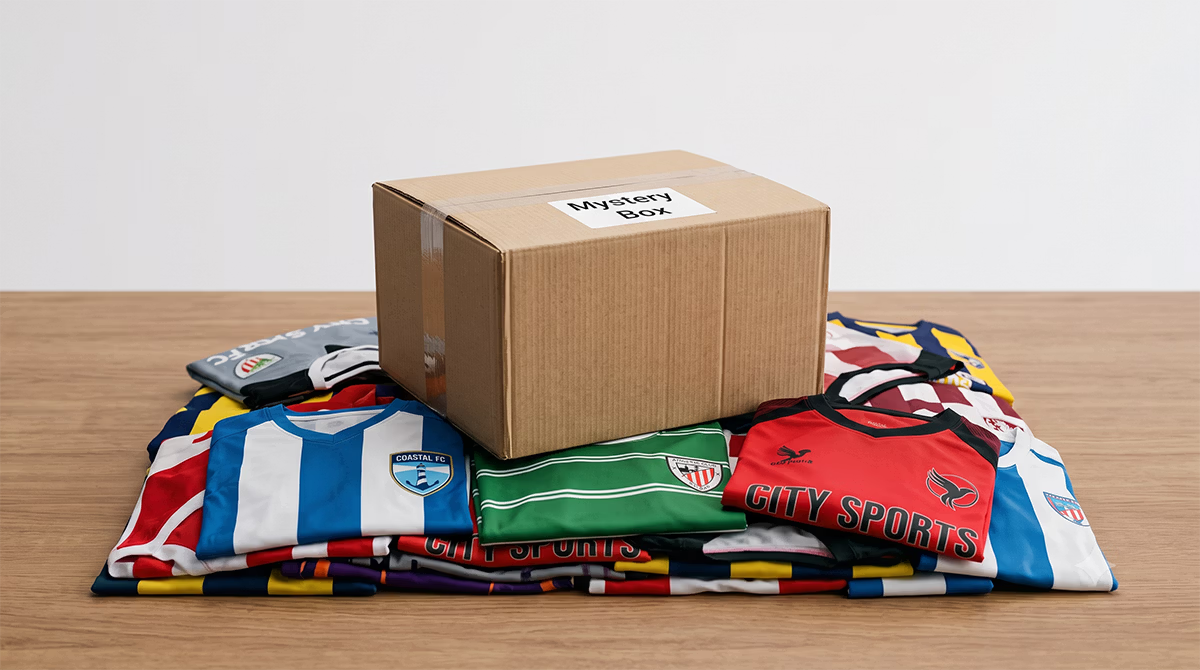
- Deconstructing Dupes: Navigating the legal gray area of "lookalikes" by analyzing specific design elements (shape, color palettes, phrasing) to determine "confusing similarity" at scale.
This allows AI to do the heavy lifting of flagging potential infringements, leaving the nuanced, high-stakes enforcement decisions to experienced IP experts.
The Future is Proactive: Stopping Fakes Before They Publish
The current standard of Brand Protection is inherently reactive: a fake is posted, discovered, and eventually taken down. Because creating a listing takes a fraction of the time it takes to remove it, brands can get trapped in a perpetual loop with progress being limited.
The future lies in proactive enforcement.
Corsearch is pioneering this shift through technologies like the Corsearch Visual Authentication Network (CVAN). The goal is to integrate filtering technology directly with marketplaces and social platforms, analyzing and blocking infringing listings at the point of upload, before they ever reach a consumer.
The legal environment is uniquely primed for this shift. In Europe, the Digital Services Act (DSA) is challenging the traditional "safe harbors" that have allowed platforms to claim ignorance.
Similarly, the US is facing increased scrutiny over Section 230 - platforms are increasingly being pushed to act as "good samaritans," adopting voluntary filtering technologies to maintain safe and legal marketplaces.
The Future Of Brand Protection
As we navigate 2026, the intersection of AI and brand protection is clear: AI is the engine that will allow brands to match the scale of modern counterfeiters.
By marrying cutting-edge AI detection with deep IP expertise, and by pushing platforms toward proactive, pre-publish filtering, brands can finally move from playing defense to going on the offense.
Ready to future-proof your brand? Learn more about Corsearch’s AI-driven Brand Protection solutions today.
See how PharmaCheck™ accelerates name qualification
From early-stage screening to post-clearance checks, we help you move faster with confidence — while avoiding missteps new, and help you move forward — faster.
Similar resources



The IP Professional's Playbook: Strategic Naming for an AI-Driven Pharma Market in 2026

The "Search & Stream" Agent: How AI is Reshaping Content Protection and Piracy Risk
.avif)
The Definitive Guide to Intellectual Property Protection

Why Pharmaceutical Naming Workflows Are Still Too Fragmented