





.svg)
.avif)








Bringing a new medicine to market can take 10 to 15 years.
The financial investment is equally significant, although estimates vary widely by methodology, therapeutic area, and how failed programs and capital costs are treated.
This puts the estimated median R&D cost at $708 million, with a mean cost of $1.31 billion per approved drug after accounting for discontinued programs and the cost of capital. Other published estimates range from roughly $314 million to $2.8 billion.
Against that level of investment, a pharmaceutical name is far more than a marketing asset: it is the foundation of the product's legal protection, regulatory strategy, and commercial launch. For IP and regulatory professionals, protecting this asset means they can ensure late-stage naming failures do not derail years of R&D.
Yet many organizations still develop and evaluate names through fragmented workflows involving separate:
- Teams
- Databases
- Vendors
- Spreadsheets and reports
This creates avoidable delays precisely when companies need to protect the return on years of R&D.
Leading pharmaceutical teams are addressing this problem by connecting everything into one workflow, allowing them to feel more confident in their decisions by reducing uncertainty.
Why pharmaceutical naming is uniquely complex
Every brand must clear Trademark hurdles - pharmaceutical names must also meet the standards intended to reduce medication errors and protect patients.
The FDA evaluates proposed proprietary names for issues including look-alike and sound-alike confusion and misleading characteristics. It also provides sponsors with a framework they can apply before submitting a name for formal review.
In Europe, the EMA’s Name Review Group examines whether an invented name could be confused with an existing medicinal product in print, handwriting, or speech.
Teams must also consider International Nonproprietary Names and protected stems. The World Health Organization advises that Trademarks should not be derived from INNs or contain common INN stems because confusion can jeopardize patient safety.
As a result, a candidate may be commercially appealing but still fail because it:
- Conflicts with an existing Trademark
- Resembles another medicine in sound or appearance
- Contains a problematic INN or protected stem.
- Creates misleading therapeutic or promotional implications
- Lacks an appropriate domain
- Cannot be protected consistently across priority markets
These risks are interconnected - a name may be legally available but regulatorily unsuitable. Another may perform well in safety testing but be difficult to protect in key jurisdictions.
The viability of a pharmaceutical name can only be understood by examining Trademark, regulatory, pharmaceutical, and commercial intelligence together.
The problem with fragmented naming of workflows
Despite this interdependence, pharmaceutical naming is often divided by function.
Trademark teams search registered and pending marks. Regulatory and safety professionals review medicinal-product names, marketing authorizations, INNs, stems, and medication-error risks. Brand and marketing teams assess positioning, memorability, linguistic suitability, and domain availability.
Each function is contributing to the same decision: Is this name safe, protectable, commercially viable, and suitable for launch?
The challenge isn't visibility anymore; it is prioritization. When teams work in separate systems, no one sees the complete risk picture early enough.
A candidate may pass an initial Trademark screen and gain executive support before a regulatory concern emerges. Another may survive regulatory review only to encounter a Trademark obstacle in a strategically important market.
By then, the organization may already have invested in:
- Comprehensive Trademark searches
- Linguistic and cultural research
- Medication-safety studies
- Brand strategy and creative development
- Packaging concepts
- Domain acquisition
- Internal approvals
- Launch planning
For a product that has already required years of development and hundreds of millions of dollars in investment, late-stage naming failures consume valuable time in the commercialization window.
By connecting these fragmented workflows, IP teams can see risk earlier and make informed decisions with confidence.
Multiple systems create hidden costs
A typical naming project may require teams to consult Trademark registers, pharmaceutical products-in-use databases, FDA and EMA records, marketing authorizations, INN and USAN resources, protected-stem lists, domains, and internal naming archives.
The issue is not the number of data sources. Pharmaceutical naming will always require broad intelligence. The problem is that the sources often sit in separate systems.
Users repeatedly enter the same names, export results, reconcile different scores, reformat reports, and track decisions in spreadsheets or email. When a project begins with dozens or hundreds of candidates, that administrative work multiplies quickly.
Fragmentation also makes important relationships harder to identify. A Trademark professional may find a similar mark without seeing that it relates to a marketed medicine. A regulatory reviewer may identify a phonetic conflict without access to the mark’s ownership, status, or jurisdictional coverage.
The most significant cost of a fragmented system is not the administrative burden of multiple platforms. It is the risk of advancing the wrong candidate or discovering a critical conflict too late.
How leading teams are fixing the process
More mature naming organizations are redesigning their workflows around the candidate rather than around individual tools.
Screen across risk dimensions from the beginning
Instead of running a basic Trademark knockout and postponing regulatory analysis, teams assess candidates earlier against:
- Trademark similarity
- Existing pharmaceutical names
- Marketing authorizations
- INNs, USANs, and protected stems
- Domain availability
- Relevant product and therapeutic information
The aim is not to replace comprehensive clearance or expert judgment. It is to eliminate weak candidates before substantial resources are committed to them.
Give every team a shared source of truth
A shared, unified candidate record offers search results, risk indicators, and decision rationales, enabling all teams to evaluate the same information and avoid duplicated efforts.
Trademark, regulatory, brand, and marketing teams can then evaluate the same information without duplicating work or relying on disconnected versions of the candidate list, helping decision-makers feel more assured and less overwhelmed by a clear, comprehensive risk view.
Use AI to prioritize, not decide
AI changes the speed and scale of analysis, helping teams recognize phonetic and orthographic relationships across large datasets.
It acts as an accelerator, but human expertise remains critical. The strongest approach combines machine-assisted analysis to surface insights faster with human judgment to determine their significance, helping teams focus on what matters most.
How Corsearch Pharma unifies the workflow
Corsearch Pharma on TrademarkNow brings name generation, candidate management, Trademark and regulatory screening, domain intelligence, collaboration, and reporting into one connected platform.
Teams can generate names or upload up to 150 candidates simultaneously, instantly screen them for potential conflicts, and review Trademark, pharmaceutical, regulatory, INN, and domain intelligence together.
This enables organizations to move from ideation to candidate selection faster, with earlier risk visibility and less manual coordination.
Generate or upload candidate names
Teams can use AI-enabled name generation or import names created by an internal team or naming agency.
Introducing screening at the point of creation helps prevent stakeholders from becoming invested in candidates that carry obvious Trademark, regulatory, or digital risks.
Eliminate unsuitable candidates faster
Instant knockout metrics allow teams to evaluate large candidate sets and quickly identify names that warrant elimination or deeper investigation.
Instead of commissioning extensive research on every candidate, teams can concentrate specialist resources on the strongest options.
Cross-reference Trademark and pharmaceutical intelligence
Users can assess candidates against connected information that includes:
- Trademark records
- Pharmaceuticals in use
- FDA and EMA information
- Marketing authorizations
- Article 57 data
- Swissmedic and Health Canada records
- INN and USAN information
- Protected stems
- Domain availability
Bringing these sources together helps reveal relationships that can be missed when Trademark and regulatory searches are conducted separately.
Compare candidates from one dashboard
An intelligent project dashboard allows teams to review risks, compare candidates, track progress, and prioritize next steps without opening separate reports for every name.
Collaborate across functions
IP, regulatory, marketing, and brand teams can work from the same candidate records. Findings, comments, and decisions remain connected to the underlying evidence, creating greater transparency and a clearer audit trail.
Report without rebuilding the analysis
Unified reporting reduces the need to recreate findings in spreadsheets and presentations. Teams can produce consistent outputs from the same intelligence used during review.
Protecting the value created through drug development
A unified pharmaceutical naming workflow cannot eliminate every Trademark or regulatory risk. Nor can it guarantee that a proposed name will be accepted by a regulator or available in every market.
It can, however, help organizations identify weaker candidates earlier, reduce duplicated effort, and make better-informed decisions before significant downstream investment is made.
For a medicine that may take more than a decade and hundreds of millions, or potentially more than a billion dollars, to develop, naming should not become an avoidable source of delay or lost value.
Corsearch Pharma helps teams:
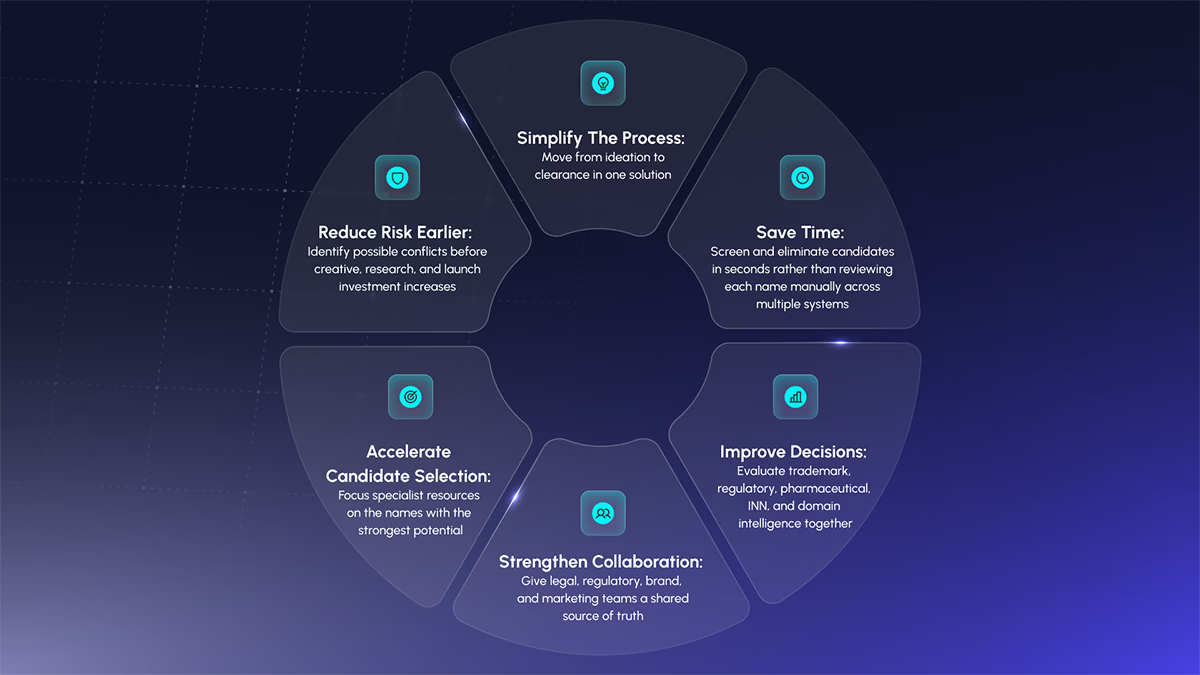
From fragmented checks to connected decisions
Pharmaceutical naming will always require specialized legal, regulatory, safety, linguistic, and commercial judgment. But complexity does not have to mean fragmentation.
By connecting name creation, screening, clearance, collaboration, and reporting, Corsearch Pharma helps teams reduce system handoffs, identify risk sooner, and advance stronger candidates with greater confidence.
The goal is not simply to complete searches faster. It is to protect the value created through years of drug development by making better naming decisions earlier.
Move from fragmented naming to one connected workflow
Discover how Corsearch Pharma can help your teams generate, screen, compare, and advance pharmaceutical names using connected Trademark and regulatory intelligence.
Know what matters. Act on what counts.
Learn more about TrademarkNow and get a tailored onboarding program from Corsearch today.
Source notes for the development-cost figures
Drug-development cost estimates vary substantially because studies use different samples and differ in how they account for failed candidates, preclinical research, overhead, and the cost of capital.
- A 2025 JAMA Network Open study estimated a median cost of $708 million and a mean of $1.31 billion for drugs approved in 2019, including adjustments for discontinued programs and capital costs.
- A separate analysis estimated an expected capitalized cost of approximately $879 million, with substantial variation by therapeutic area.
- An earlier JAMA analysis reported a median capitalized cost of approximately $1.1 billion and noted that published estimates ranged from $314 million to $2.8 billion.
- Published descriptions of the conventional development process commonly place the discovery-to-approval timeline at approximately 10 to 15 years.
See how PharmaCheck™ accelerates name qualification
From early-stage screening to post-clearance checks, we help you move faster with confidence — while avoiding missteps new, and help you move forward — faster.