






.svg)
.avif)





.svg)



We brought together a group of media and entertainment leaders within the brand protection community to discuss recent changes to the industry and challenges they are facing.
What changes have media leaders seen online?
Over the last 18 months, there’s been a noticeable change in how online infringement – content piracy and counterfeiting – generally operates. Fundamentally, there’s been a huge proliferation in illegitimate activity across e-commerce, social media, and online media platforms like YouTube, Google Play, and iTunes.
As media companies shifted their growth strategies to even more of a digital focus, brand protection teams have had to align their budgets and efforts to online infringement, too. Whilst offline programs are still important, these threats aren’t at the scale they were previously.
It’s vital organizations are structured to prioritize online over offline, as this is a permanent shift. While threats and consumer behavior will always evolve and fluctuate, it’s clear online is now the main focus.
Consumer safety the top concern for media leaders
Media companies depend greatly on trust to uphold their business strategies. Not only consumer trust built through quality content, merchandise, and digital experiences, but also the trust of licensees.
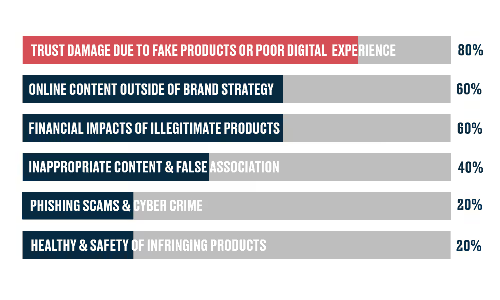
A poll of media leaders saw 80% claim the issue of trust to be a top concern they currently face online.
What are the financial concerns for rights owners?
All of these threats have financial implications, whether direct or indirect. All IP infringements have the potential to harm investments. Brand protection teams are in place to support revenue growth, improve margins, and increase dividends and share prices.
Teams therefore focus on reducing any factors that can undermine these strategies. Reputations can be significantly impacted by piracy and counterfeiting. This can damage the trust of consumers, which is a major concern. But it can also harm relationships with internal partners, licensees, agents, and broadcasters.
If they don’t have faith that the rights owner is competently protecting their product, it has been known for partners to pull out of deals or reduce their investments. A no-tolerance approach, therefore, is essential.
What unique challenges do media companies face?
One of the nuances of media and entertainment is how infringers can get ahead of releases. When launching product range for instance, if threats haven’t been managed, the level of counterfeiting can be extremely problematic, particularly in emerging territories.
Content – TV shows, movies, music, games – comes first, and products come later. In the meantime, there’s an opportunity for counterfeiters to move fast and penetrate the market before legitimate products arrive. This is unlike other sectors like fashion or consumer goods, where brands are able to release a fresh product, knowing that it’s landing in the market for the first time.
And the nature of the internet allows infringers to move faster and gain a broader reach. It’s therefore vital for brands to vital to clear the way for these kinds of launches.
If, for example, a brand releases season one of a series and it gains a good fanbase, a solid strategy would be to launch a range of merchandise alongside the season two release.
However, without a sophisticated brand protection program in place, infringers will have penetrated the market long before season two. And local licensees may see the scale of the problem first, damaging those relationships and making future partnerships difficult.
How do brand protection teams secure investment to stay ahead of threats?
Often the business sees content piracy as the main issue, and the level of focus on resource directed to that issue is good. However, it can be difficult to secure budget elsewhere for IP protection. Our media leaders gave some advice on how to secure investment.
Position IP protection as a business issue, not a legal issue. It’s not solely about protection IP in a legal sense. It’s about saving money, or making money – protecting investments in content, marketing, product.
Many businesses don’t fully understand the potential, and it can be quite difficult to accurately calculate the return on investment. But it is helpful to gain some industry benchmarks or estimates to secure buy-in. In some cases, for every dollar invested into brand protection efforts, 10 dollars are generated in protected or additional revenue.
Using online brand protection software, it’s possible to gain good data around sellers, listing volumes, and the values sellers generate per listing, to calculate the potential revenue protected or litigation value.
It’s been known for other areas of business to see the program as failing if threats are increasing, making securing greater investment difficult. In this case, it’s important to prove the need for more budget. Show real data as to how problems have grown, through no fault of your program.
Find opportunities to apply data and intelligence, adding value where the business wants to grow. Perhaps there are untapped territories or potential sales channels that your data can reveal.
It can be difficult to continually increase program budget in isolation, so look to align with other teams such as marketing or e-commerce. Budget spent here is seen as a strategic growth investment as opposed to a legal cost centre. Investments can be in line with campaigns, where budgets are typically large.
In some instances, brands have been able to collect data on illegitimate sellers or distributors and convert them into legitimate licensed partners, turning infringing activity into a growth opportunity.
In some cases, it’s possible to recoup costs through mass contingency litigation. Enforcement efforts can uncover significant funds in online e-commerce platform accounts, which can offset annual costs through litigation.
What issues do media companies face with online platforms?
Copycat content
Online media platforms such as YouTube have lowered the barrier to entry for copycat content. In fact, some brands reported how copycat versions of their own content had become their greatest competition, more so than rival companies.
Inappropriate content
The influx of user-generated content and the nature of these platforms holds inherent issues for brands. Influencers, superfans, and parody accounts create inappropriate content linked to brands, or sample and manipulate legitimate content in inappropriate ways, potentially damaging reputations.
Ineffective action
Many leaders spoke about how the policies need to change so the onus more on the infringing party, as current policies place a large burden on the rights owners. Or platforms could make it easier for rights holders to file arbitration.
Again, this is a nuanced issue for the media and entertainment sector. FMCG, fashion, electricals and other sectors can force the hand of platforms with issues around the safety of counterfeit products. They can also negotiate using commercial discussions and leverage their investments in advertising to work with platforms and counter infringers.
However, media companies don’t always have the same leverage, particularly on platforms like YouTube, where the main source of revenue is advertising. If a video is driving high volumes of traffic to an ad, the platform isn’t always invested in whether the content is infringing or not.
How can media companies work together to combat issues?
Collective Enforcement
There are occasions where individual cases are brought to the attention of brands, but these can often be too difficult to allocate resource to. Costs are disproportionally high, and enforcement, particularly offline, can be difficult to coordinate at a local level. Many of the media leaders discussed the benefit of collaborating here as a way of splitting costs and reducing the burden on individual teams.
Lobbying Platforms
The leaders agreed that significant progress could be made if brands pulled together to continue sharing their experiences, and lobby for change in regulations and arbitration procedures. At Incopro this is something we wholeheartedly agree with. It’s one of the many reasons behind the creation of INSYNC – to drive global change in platform practices and empower rights holders with positive change.
See how PharmaCheck™ accelerates name qualification
From early-stage screening to post-clearance checks, we help you move faster with confidence — while avoiding missteps new, and help you move forward — faster.
Similar resources


.avif)
The Definitive Guide to Intellectual Property Protection
Research Indicates That 40% of Football Jersey Mystery Boxes Are Counterfeit


Moving from Defense to Offense: A Strategic Framework for Brand Protection


.avif)