






.svg)
.avif)





.svg)



The scale of the fake goods problem reinforces the fact that counterfeiters are increasingly sophisticated. The UK alone loses billions of pounds each year due to counterfeit products being shipped in from abroad and evading VAT, according to a BBC Panorama investigation.
Looking into the effects of counterfeit goods on brand value, independent market research commissioned by Corsearch found that 92% of the 1,000 UK consumers surveyed said they look for warning signs when shopping online. Price (69%) is seen to be the biggest indicator of how to spot counterfeit goods, as something too good to be true usually is. But once you move beyond price it starts to get more complicated.
While individuals consider the website (44%), customer reviews (44%), country of the online seller (41%), imagery (39%) and the quality of description (38%) when evaluating products online, there is no escaping the fact that people are still being ripped off.
But even though consumers may be well aware of the counterfeiting threat, it is becoming increasingly harder to spot the real deal online.
In this blog, we’ll explain how to spot counterfeit goods online by looking out for the following:
Prices that are too good to be true
A hallmark sign of a counterfeit product is that it costs a fraction of the price of the genuine article and “appears” to be identical.
Fraudsters use inferior materials to create these “replicas” which, while costing them next to nothing to produce and market these products, are also putting consumers at risk.
A 2018 report from the Government Accountability Office revealed that counterfeit iPhone adapters can pose a risk of lethal electrocution, counterfeit travel mugs can include higher lead concentrations, and counterfeit cosmetics contain substances such as cyanide, mercury, and rat droppings.
Remember, if the price of an item is way below market value, sold by an independent seller and discounted by 60-80%, chances are it’s not real.
An untrusted and/or dubious website
When consumers can’t find an agreeable price for a product on a brand’s own website, most will turn to other third-party sites or marketplaces to find the best deals.
It’s for this reason that online marketplaces have become a hotbed for counterfeit sellers, steering customers to their own products by undercutting the prices of the legitimate items. We mentioned before around suspicious pricing, but another key sign of counterfeiting is where the product or item is being sold.
Before making a purchase on a website you don’t recognise, paste the web address into a domain checking tool such as Whois Lookup to find out where the seller or company is located. If the address is not listed or has been left out, that should raise suspicion.
Also, if the website has any grammatical or spelling errors, that too should sound alarm bells, especially if there are any errors in the website URL or the product information. Often the people behind these fraudulent sites don’t pay attention to the details or may try to deceive buyers by changing the spelling of a well-known brand or shop and including it in the website address.
Where possible, only buy directly from a brand’s website as this will ensure security and quality of product.
Customer reviews and seller profiles
Tying into the previous point are customer reviews and seller profiles.
Customer reviews on independent review platforms help online shoppers ascertain the validity of a certain seller and/or marketplace, providing the confidence they need to shop on certain websites.
Not all sellers are fraudulent, and reviews will help to prove that fact. How many reviews does the product have? What is its average rating? Does anybody say it feels cheap and fake?
Seller profiles can be another way to check the legitimacy of products. Some online marketplaces provide platforms for sellers to list their own products rather than reselling a retailer’s branded products, so checking where the seller comes from and if they have their own reviews from previous buyers can help spot a fake before it’s too late.
Country
According to the 2017 Situation Report on Counterfeiting and Piracy in the European Union, a joint research project between Europol and EUIPO, China is the “engine of the global counterfeiting industry.”
It’s estimated that 72% of the counterfeit goods currently in circulation in the world’s largest markets for products – EU, Japan and the USA – have been exported from China.
Behind China are Turkey, Thailand, Singapore and Malaysia. The majority of counterfeit goods from these countries arrive at EU external borders, via sea, air or land routes. Once the goods are in the EU they can easily be reshipped elsewhere.
Taking this into account, checking where the seller is based or where the product is coming from is essential.
Imagery
According to Gregg Marrazzo, senior vice president and deputy general counsel of Estee Lauder Companies Inc, the only way to purchase an authentic product is “at authorised stores and counters”.
The problem is that counterfeit goods can “quite often appear to be authentic”, Marrazzo states, so consumers shopping online need to carefully check the details.
When purchasing products from online marketplaces, see if there are any images of labels, receipts, country of manufacture and the design of the product. Try and compare it to the same product on the brand’s own website to spot any deviations in workmanship or detail.
Item description
Finally, the item description – an area fraudsters often neglect.
Buyers should always check the product description, especially in instances where they are uncertain or sceptical of a seller or website – perhaps the item has a significant discount, or the seller is based in one of the main counterfeit-producing countries as mentioned above.
Carefully analysing the product description of the fraudulent product and cross-referencing it with the legitimate product will reveal inconsistencies or a complete lack of certain information.
Final thoughts
Although these factors are excellent indicators of counterfeit goods, the growing sophistication of those selling fake items is making it increasingly difficult for consumers to spot them.
Combatting counterfeits requires intelligence-led technology, technology that allows for the identification of infringers through web and image searching
At Corsearch, we develop and deploy intelligence-led Brand Protection solutions to help brands protect their products and services and defend the brand they have built online. Our technology helps to uncover the biggest threats to brands and identify and protect against counterfeiting networks.
See how PharmaCheck™ accelerates name qualification
From early-stage screening to post-clearance checks, we help you move faster with confidence — while avoiding missteps new, and help you move forward — faster.
Similar resources


.avif)
The Definitive Guide to Intellectual Property Protection
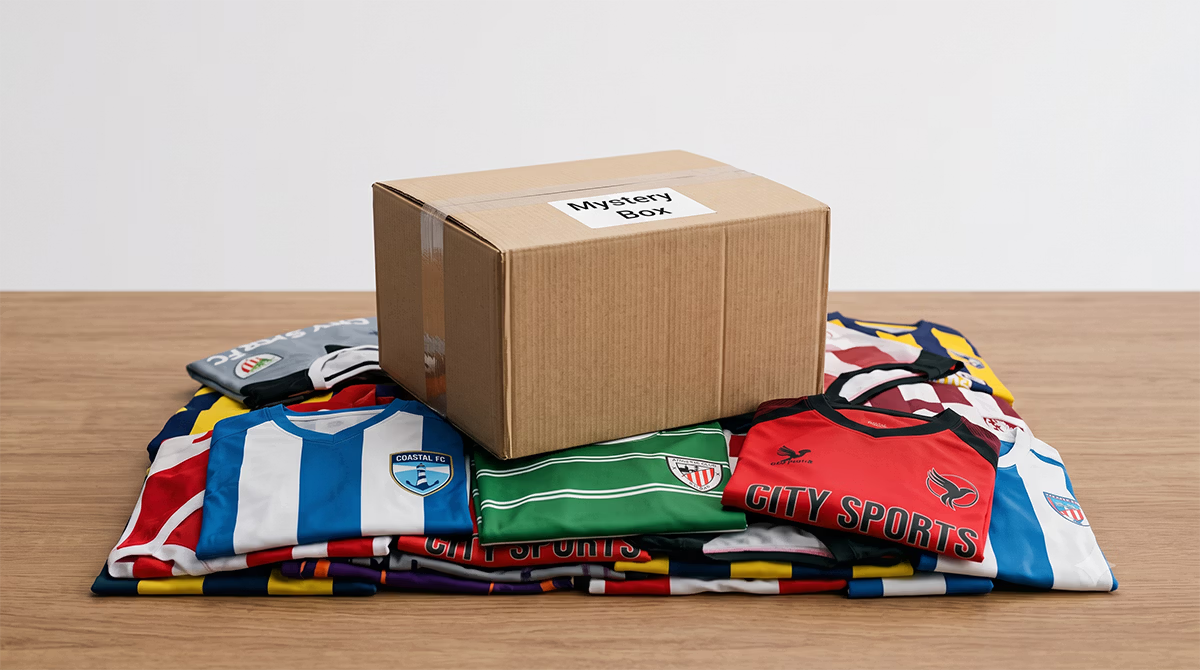
Research Indicates That 40% of Football Jersey Mystery Boxes Are Counterfeit


Moving from Defense to Offense: A Strategic Framework for Brand Protection


.avif)