







.svg)
.png)









Indice dei contenuti:
• What is Intellectual Property (IP)?
• The importance of Intellectual Property protection
• What Intellectual Property threats should you be aware of?
• The Intellectual property protection tools at your disposal: Intellectual Property Rights (IPR)
• How to protect your IP and brand online
What is Intellectual Property (IP)?
Put simply, IP refers to something you have created that is unique. This could be:
- Business names
- Slogans
- Logos
- Designs
- Colors
- Software
- Domain names
- Documentazione
- Musica
- Symbols
These inventions, creative works, and ideas are some of the most important aspects of a business, and that is why it is crucial to ensure you have the tools in place to prevent unauthorized use or reproduction.
Copyright protects creators against the ability to reproduce, distribute, display, perform and create derivative works based on the original creation. And – while they are normally granted automatically upon creation of the work – obtaining a registered copyright provides you with much more protection.
The importance of Intellectual Property protection
Having a strategic and carefully planned IP strategy is vital if you want a successful and profitable business. By understanding and implementing IP protection strategies, you can:
- Enhance market value
- Attract investors and partners
- Turn ideas into profit-making assets
- Market your products and services
- Gain a competitive edge
- Enhance export opportunities
- Avoid and mitigate risks
Who is responsible for Intellectual Property protection?
Intellectual Property protection is primarily the responsibility of the creators, inventors, or owners of the Intellectual Property. However, the enforcement and legal aspects of IP protection may require a collaborative effort from individuals, organizations, and government bodies.
As well as understanding the business benefits, you also need to be aware of what happens when you don't protect your IP.
Not having the right Intellectual Property protection in place or a comprehensive understanding of what qualifies as an infringement can have a significant impact on your company’s ability to grow and become profitable. There are thousands of examples online, showcasing the detrimental impact on businesses when they lose control over how their brand is experienced online. Poor-quality counterfeits, social media scams and inappropriate brand associations all contribute to an erosion of trust which can lead to a significant dent in your reputation and financial loss.
Plus, bad actors and criminals move fast. Any sign of weakness can be exploited to secure their own financial success. Unfortunately, they can also be very good at what they do, meaning consumers can be none the wiser when it comes to telling apart the real from the fake.
With one in two US consumers (52%) losing trust in a brand after unintentionally purchasing counterfeit goods online1, it is down to businesses to ensure they are taking the right precautions to stop these bad actors and criminals in their tracks and prevent this breach of trust.
As well as intentional infringement, sometimes a company can infringe another company's rights without realizing it. You have a responsibility to ensure you are aware of not only the IP threats, but also the rules and IP laws in place to avoid unintentional infringement.
Intellectual Property theft costs the US economy up to $600 billion annually.
Source: The Intellectual Property Commission
Who are the bad actors?
While some bad actors are out to make a quick buck by creating fakes or cheap knockoffs, others have far more sophisticated scams in place and continue to return time and time again.
These include repeat infringers, who consistently adapt their tactics, making them harder to detect and penalize; and criminal networks, which could be made up of hundreds of employees operating as its own business, creating multiple pages, listings and profiles across different platforms.
Who and what do they target?
The most common brands and types of products & trademarks targeted include:
- Products that are finite or limited run
- Products that aren’t finite, but demand exceeds their supply
- Products that aren’t available in certain regions
- Products that have a high mark up
- Products that are simple to copy
- Brands known for great customer service
- Brands and trademarks with global appeal
- Trademarks that are easily misspelt
The Intellectual Property protection tools at your disposal: Intellectual Property Rights (IPR)
As we have established, IP is a broad term that encompasses several categories. Each of these categories comes with their own sets of rules and protections, so it is important to be aware of the different types of Intellectual Property Rights (IPR) and what they protect against.
Copyright: Protect your creative works
Copyright grants exclusive protection to creators of original works and stops people using your work without permission or claiming it as their own.
Copyright law relates to expressions of ideas in material form. This includes things such as writing and literary works, art, photography, cinematography, audio, web content and software. It is important to note that copyright only relates to the tangible expression of ideas, not the ideas themselves. Things such as titles, names, slogans, or concepts aren't included.
Copyright protects creators against the ability to reproduce, distribute, display, perform and create derivative works based on the original creation. And – while they are normally granted automatically upon creation of the work – obtaining a registered copyright provides you with much more protection.
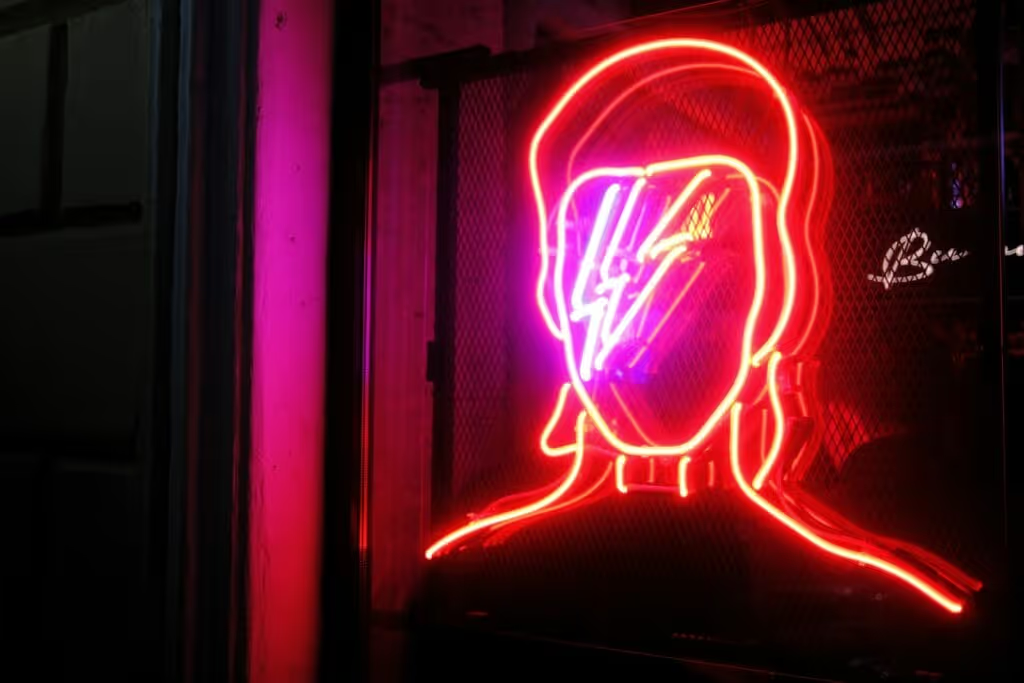
Famous copyright infringement case – Vanilla Ice vs David Bowie & Queen
If you want to use or sample a piece of music that you didn't create, you must ask for permission. This was something Texan-born rapper and actor Vanilla Ice forgot to do when he produced his 1990 hit track 'Ice, Ice, Baby'. The riff on the track was alleged to be sampled from David Bowie and Queen's 1981 hit 'Under Pressure’, however neither of the artists were credited or offered royalties by Vanilla Ice, leading to a legal dispute.
The case was settled privately out of court, with Vanilla Ice believing to have paid $4 million to purchase publishing rights to the track and crediting David Bowie and Queen as songwriters.
Trademarks: Protect brand identity
Trademarks are used to protect brand names, words and logos associated with products or services. They play a crucial role when it comes to protecting your brand from others and have a significant impact on marketplace recognition.
You can register a trademark as a multitude of things, such as logos, slogans, designs, colors, sounds, and even scents. As long as they are distinctive and recognizable, they can be registered and associated with your brand.
There are also many things you cannot trademark. Names and logos that are similar to existing trademarks and generic terms and phrases that aren't recognizable on a brand level do not meet the criteria and cannot be protected.
It is also worth noting there are different levels of protection available, depending on whether you have a registered or unregistered trademark. Many countries give you the option to use words, phrases or logos as a trademark to identify you or your company as the source of certain products or services without having to apply to register a trademark. This is known as 'common law’ and the rights granted differ depending on regional requirements.
By registering your trademark, you get nationwide protection across the country where it is registered, legal presumption of ownership and validity, use of the ® symbol next to your brand or business name and exclusive rights to use, license, franchise or sell your mark.
85% of brands say they have experienced trademark infringement
Source: MarketingWeek, 2019
Famous trademark infringement case – Louis Vuitton vs Louis Vuiton Dak
Louis Vuitton is a globally recognized brand that operates in 50 countries with more than 460 stores worldwide. As well as trademarking 'Louis Vuitton', its initials 'LV’ have also been trademarked since 1890.
Trouble occurred a few years ago, when Korean fried chicken restaurant, 'Louis Vuiton Dak', was sent a cease-and-desist letter from Louis Vuitton, who believed the restaurant's name was too similar to theirs. In addition, Louis Vuitton claimed the restaurant's logo and packaging was also remarkably like their imagery, citing it would cause customer confusion.
The court ruled the case in the designer’s favor and ordered the restaurant to change their name. Trouble did not end there however, as the restaurant was then hit with a $12.5 million fine

Patents: Protect the way it works
Patents are designed to protect the workings of an invention, such as a tool, a machine or a process. Patents can only be obtained if your invention is something that can be made or used, has a technical effect, and is new rather than a moderation of something that already exists.
Examples of patents include industrial processes, medicines, computer hardware, games and business methods.
Obtaining a patent prevents others from replicating, using or selling the invention and gives the patent holder sole rights to an invention, product or process.
Famous patent infringement case – Polaroid vs Kodak
There have been a number of famous patent infringement cases to date, and one of the most famous cases took place in the 1970s between photography giants Kodak and Polaroid.
Edwin Land, the founder of Polaroid, had developed and patented the instant photography process that Polaroid is famous for. In 1976, Kodak launched its own line of instant cameras, prompting Polaroid to file a lawsuit against them, citing that no less than twelve of their patents regarding instant photography and the technology associated with it had been infringed.
This legal battle lasted for years, and eventually it was ruled that Kodak had infringed on Polaroid's patents. Kodak was ordered to cease production of its instant photography products and pay an eye-watering settlement of $925 million.

Designs: Protect the way it looks
Design rights, otherwise known as industrial design rights, protect the appearance and look of a product you have designed, providing it is new and has individuality.
Design rights can be obtained for different visual forms, such as lines, shapes, textures and materials, and, like trademarks, designs can be registered or unregistered, depending on your location.
Under UK law, the shape and configuration of unregistered designs have protection against copying for 10 years after the design was first sold, or for 15 years after it was first created. This is known as ‘design right’. You must also allow other people to use your industrial design if they ask during the final 5 years of protection. This is known as a ‘licence of right’.
The appearance of a product is protected in the UK and EU for only 3 years from the date you make your design public if it is not registered. It is also worth noting that the United States currently offers no legal protection for unregistered designs.
Registering designs provide much better protection for a longer period of time and provide the owner with exclusive rights to prevent unauthorized copying or imitation. They are also relatively low-cost and easy to obtain, offering a simple solution to increase the commercial value of your business or products.
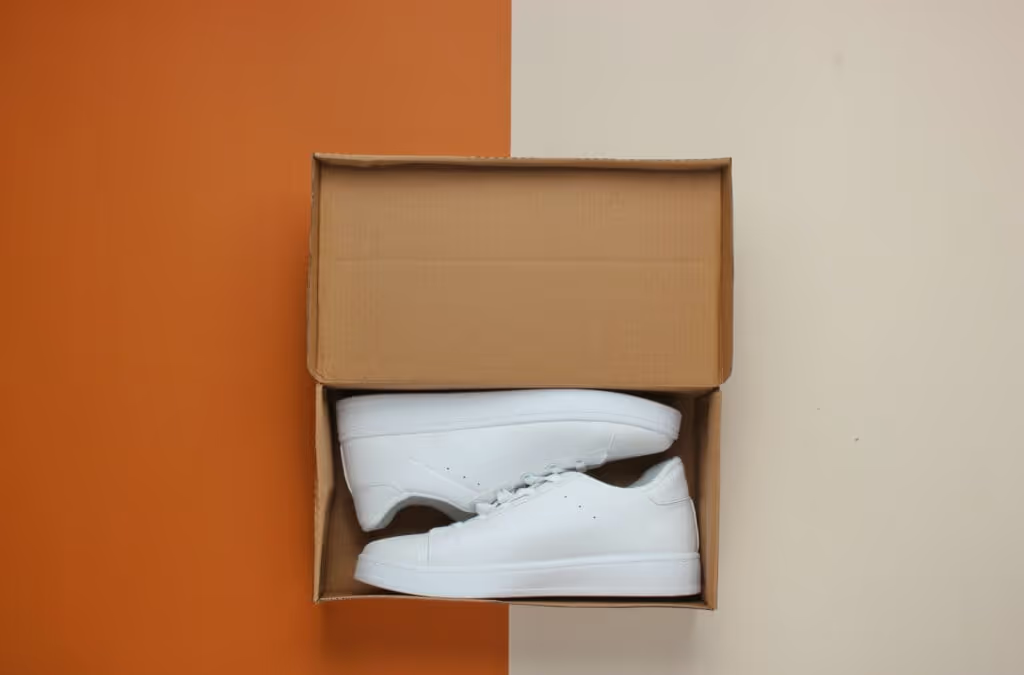
Famous design infringement case – Adidas vs Payless
When you think of Adidas, its iconic three stripes are often the first thing that comes to mind.
These stripes were the cause of a famous lawsuit in 1994, where Adidas filed against value-priced retailer Payless, who were selling athletic shoes with two and four parallel stripes. The two companies managed to reach a settlement, however in 2001, Payless were found to be selling the lookalikes again. Adidas claimed the low-cost shoes on offer from Payless could tarnish its brand by association with a lower-quality product and demanded a jury trial.
Spanning seven years, the result was in favor of Adidas, who were awarded a staggering $305 million.
Studio di caso
Lipsy Protects Consumers from Counterfeits & Safeguards High-Value Celebrity Partnerships with Corsearch
Sheena Yonker, Senior Brand Protection Manager di Lipsy London, spiega come la protezione del marchio sia fondamentale per proteggere la ragazza Lipsy dalle contraffazioni e per salvaguardare le esclusive collaborazioni con le celebrità che il marchio ha lavorato duramente per assicurarsi.

"Quando abbiamo scoperto Corsearch, il gioco è cambiato. Siamo stati conquistati dalla tecnologia. La tecnologia di Corsearch per la protezione dei marchi è incredibilmente potente, con una corrispondenza di immagini avanzata che ha una capacità e una scalabilità di gran lunga superiori a qualsiasi altra cosa avessimo utilizzato in precedenza."
Sheena Yonker, responsabile della protezione del marchio, Lipsy
Next steps: How to protect your IP and brand online
We hope this guide has given you a clearer picture of the IP landscape and the threats you should be looking out for. The next step is to actively protect your brand from would-be thieves and criminal operators online.
At Corsearch, we combine the power of AI-fueled technology and expert analysts to help businesses establish, monitor, and protect their brands with confidence. From trademark clearance and watching to anti-counterfeiting and IP protection solutions, over 5,000 customers choose Corsearch to prevent consumer confusion and safeguard trust.
Scopri come PharmaCheck™ accelera il processo di verifica dei nomi
Dallo screening iniziale ai controlli successivi all'autorizzazione, ti aiutiamo ad agire con maggiore rapidità e sicurezza, evitando errori e consentendoti di andare avanti più velocemente.
Risorse simili


Protezione del marchio: La minaccia dei social media - Una prospettiva per la moda e il lusso





I tre componenti chiave di un programma di protezione del marchio di successo



Come le ricerche di design industriale traggono vantaggio dall'intelligenza artificiale

Uno sguardo nelle tenebre: Un mondo in cui i vostri marchi sono gestiti da cattivi attori

Sul tuo marchio! La guida di Corsearch per sapere quale marchio osservare, come e quando.
Analisti e IA: quali sono le prestazioni migliori nella liquidazione dei marchi?

Come i cattivi attori si preparano alla stagione delle vacanze

Radar del rischio del marchio: Panoramica delle minacce



La Guida definitiva ai marchi: Liquidazione, violazione, ricerca e acquisto

Il falso è il nuovo reale? Vivere in una società falsa - USA

Truffe, falsi e abusi di marca nel settore dei beni di largo consumo: come proteggere i consumatori e tenere testa alle minacce
Farmaci contraffatti: una minaccia online in crescita e come proteggere i consumatori

Il falso è il nuovo reale? Vivere in una società falsa - Regno Unito
Tre colpi e via: come le piattaforme di e-commerce possono proteggere i consumatori dalle violazioni ripetute
Motori di ricerca: È tempo di fare un passo avanti e di affrontare le contraffazioni



Corsearch chiede a Cloudflare di fare di più per proteggere i consumatori e i titolari di proprietà intellettuale